Follow CUcheatsheet on Twitter
Showing posts with label Interest Rates. Show all posts

Friday, April 9, 2010

Fed says inflation tame, no need to raise rates soon


Federal Reserve policy makers last month saw an inflation slowdown across the U.S. economy that may persist in the coming months, tempering any need to reverse record-low interest rates. At the same time, the Fed said its pledge to keep the main rate low for an “extended period” wouldn’t keep it from taking action when needed to keep inflation in check, according to minutes of the March 16 Federal Open Market Committee meeting released April 7th. A few officials warned of the risks of increasing borrowing costs too soon.

The inflation outlook, coupled with Fed officials’ concerns about unemployment and long-term joblessness, signals Chairman Ben S. Bernanke and his colleagues are still looking for evidence of a sustained rebound from the worst recession since the 1930s. Fed staff economists reduced their 2010 and 2011 forecasts for inflation excluding food and energy, projections that were already below 2009 rates. “If you expect moderate growth and high unemployment and decelerating inflation, which is still likely to be the best guess at the moment, you won’t be interested in raising interest rates right now,” said former Fed Governor Lyle Gramley, a senior economic adviser at Potomac Research Group in Washington.

At the meeting last month, central bankers left the benchmark federal funds rate target, covering overnight interbank loans, in a range of zero to 0.25 percent, where it has been since December 2008. Fed officials cited the job market, lower home prices and tight credit as restraints on the recovery, the minutes said.

By Scott Lanman
April 7 (Bloomberg) --

Tuesday, February 16, 2010

Does interest on Fed deposits spell the end of the Corporates?


In October 2008, Congress granted the Fed power to pay interest on both required and excess reserves for the first time. Before then, the Fed never paid any interest on bank reserves. After the WesCorp and US Central debacles and the resulting required shift towards safer and lower yielding investments, it's unclear how the corporate credit unions can continue to compete with the Federal Reserve. A handful of credit unions have already made the jump from a corporate to the Fed.

This new policy is a game changer. Before, the Fed could only raise interest rates by making reserves scarce relative to demand. This was done by "open market sales," or selling government bonds and debiting the reserve accounts of banks. The reduction in the supply of reserves sent the interest rate on reserves upward. That is how the Fed controlled the interest rate on the all-important Federal Funds Market, the market for overnight reserves that the banks lend each other to satisfy both the Fed's reserves requirements and their own liquidity needs.

Now the Fed can maintain a large quantity of reserves to satisfy the banks' desire for liquidity and still fight inflation by simply raising the interest rate that its pays on reserves without removing. The interest rate must set the floor to the Federal Funds and other short-term rates since no financial institution would loan out reserves in the Fed Funds market at a lower rate than they can receive on deposit from the central bank. The Fed can now raise rates and maintain the liquidity of our banking system.


(Derived from yahoofinance.com article)

Saturday, January 23, 2010

The US dollar and looming interest rate risk

Just two months ago, economists were predicting a protracted fall in the strength of the US dollar. But since then, the the fundamental and technical evidence points to a rebounding U.S. dollar, at least in the short term. This is significant because continued demand for the relative safety of US Treasuries could mean interest rates should remain on the low side for the foreseeable future. Maybe six months.

No alternatives - flight to safety

If the US economy was isolated from the rest of the world, US government (record deficit-spending) policy responses to the financial crisis should send the dollar into a free-fall. But economic problems are global and threaten the sustainability of a global recovery. That makes investors nervous, and when they’re nervous, they prefer to own US dollars. Global investors responded to the uncertainty by plowing money into the U.S. Treasury market. Currency values are determined as compared to the value of other currencies. With that in mind, the dollar is positioned to strengthen. However, at the risk of stating the obvious, things could change rather quickly once the global economy improves.

A January 2010 Bloomberg poll indicates of how quickly perception can shift. According to the poll, investors have turned bullish on the U.S., a stark contrast from the views just a quarter ago. It turns out the rest of the world is in poor economic shape. Comparatively speaking, the U.S. and the dollar appear stronger for the time being.

Interest Rates

Granted, there is no clear correlation between US dollar and nominal interest rates. But as long as there is demand, Treasury rates, which affect mortgage and other borrowing rates, probably won't need to rise as quickly in order to attract investors. That said, record deficits harbor the risk of inflationary pressures. Higher rates inevitably follow.

If you held a gun to my head and forced me to make a prediction, I'd say Treasury rates should stay steady for about six months before beginning a prolonged rise. This gives financial institutions a small window of opportunity to get their balance sheets in order. Interest rate risk looms as the next major hazard to their bottom line, as well as to the US banking system.

Tom Dluzen

Tuesday, October 27, 2009

A New Proposal: Immediately Freeze Credit Card Rates.

According to the Wall Street Journal, Sen. Christopher Dodd, who heads the Senate Banking Committee, introduced a measure that would freeze rates on existing card balances until February, when the new CARD Act rules are to go into effect. "No sooner had it been signed into law, but credit card companies were looking for ways to get around the protections," Mr. Dodd said in a written statement.

Dodd's move is part of an effort by leading Democrats to crack down on what they see as gaming of the new rules by card issuers. Reps. Barney Frank (D., Mass.) and Carolyn Maloney (D., N.Y.) have introduced House legislation that would move up the effective date of the new restrictions to December from February. As I wrote in a recent blog, the House Financial Services Committee has approved the accelerated date.

Thursday, October 8, 2009

Figure on Higher Mortgage Rates by Spring

According to the Kiplinger Letter, 30 year fixed mortgage rates will be in the neighborhood of 6% this Spring, even higher if the recovery is stronger than expected and businesses start selling corporate bonds to fund capital investment projects.

The upward push will come just as the Federal Reserve quits buying mortgage debt. Right now, the Fed is buying 80% (!) of home mortgages being written, filling in for a largely absent private secondary market. But the Feds efforts to keep rates low and prop up the housing market is slated to wind down between now and March 31st.

Incidentally, the reasons investors are staying away from purchasing mortgages in the secondary market are many: Oh, but my broker says not to worry! This is a subject for another day, but excercise caution if you decide to go this route. You might be buying great risk if you are reaching for yield.

Wednesday, October 7, 2009

Interest Rate Chonicles. The Weak Dollar.

The U.S. dollar is weak. That doesn't sound good does it? But Wall Street loves it . . . a weak dollar improves corporate profits by making U.S. goods cheaper to overseas buyers. Companies can also improve profits when they convert sales made in foreign currencies to dollars. Conversely, imports become more expensive.

How does this affect interest rates? Yesterday, Australia's central bank became the first G20 country to raise interest rates. Others may soon follow. This could prompt investors (read China) to sell dollars as they look to put their money into markets where interest rates are rising. The US then would have to raise rates to attract investors to finance our RECORD deficit borrowing.

Wouldn't you love to have the President's job? It would be a hoot to just spend an unlimited amount of money. Whoops, just ran out . . . that's OK, just print some more! (Don't get any ideas, you and I go to jail if we print money). By the way, this is a sure recipe for inflation (yep, inflation also means higher rates).

Ok, so you produce your ALM reports every quarter. Nice work. Keeps the examiners happy, right? But is anyone actually using the reports to form a strategy to reduce interest rate risk? Your ALM results are probably looking pretty good right now, but keep in mind that with interest rates HISTORICALLY low, those rosy numbers are skewed favorably and can change in a hurry. Do a couple of "what if" analysis and you'll see what I mean.

Let's face it, interest rates have no where to go but up, the question is when.With all the other problems plauging the industry, it's easy to take your eye off of Asset Liability Management. But your current problems could look like a walk in the park if you get caught on the wrong side of the rate risk equation.

Friday, September 4, 2009

Short-Term CDs, a Lullaby.

Remember the sweet little lullaby Rock-a-bye Baby? - It's very soothing, puts the baby to sleep, nice. That is until you consider some of the lyrics: "When the bough breaks, the cradle will fall. And down will come baby, cradle and all".

Market Rates Insight has released a new analysis which confirms what most of us already know. Members are eschewing long-term CDs for short term deposits. This has been the trend for at least the past year, and as a result, the typical credit union's cost of funds has dropped rather quickly and significantly. Since deposit interest rates are historically low and you still hold loans and investments booked during a period where rates were higher, your bottom line is looking better (aside from loan losses, a Brother's Grimm story). Heck, you can even run a loan special a very low rates, right? "Rock-a-bye baby. . ."

Flash forward. Rates begin to rise, and all that short-term money begins to reprice. Quickly. Within a year. You hear someone say, "hey, what's happend to the bottom line? It turned all red". That loan special you were so proud of? No one is claiming credit for that brain-child anymore; and "down will come baby, cradle and all. . ."

The good news? Rates probably won't move much within, say, the next year or so. But once they do, they can move quickly. Age-old advice that the wizened give - be forward looking and get your balance sheet in order, you might have a little time.

Wednesday, August 12, 2009

The Story Behind the Fed Funds Target Rate Announcement.

The Feds left the target rate fed funds interest rate range steady at 0% to 0.25%. This was no surprise. Perhaps more importantly, though, they announced that they will begin reducing the amount of Treasuries they have been buying to help offset the amount of debt needed to cover the government's spending spree. This could reduce demand and contribute to a rise in the 10 year Treasury rate. The 10 year rate affects mortgage, commercial, and other consumer loan rates. Diminished demand for Treasuries will drive rates upward, as rates must increase to attract investors. Some other forces that could affect demand for Treasuries:

1. With more confidence in the economy, investors may move their money out of the safety of Treasuries and into investments that provide a higher yield.
2. The government will need to issue more debt (treasuries) than at anytime in our history, increasing supply.
3. Some say that foreign investors may begin reducing their purchases of our debt, or simply would not have the capacity to purchase the trillions in debt necessary to fund the stimulus and new White House initiatives.

If the government would have to raise the interest it pays on it's debt due to increased supply and decreased demand, it would prematurely drive up borrowing costs at a time the economy appears to be on the cusp of recovery.

Did you know that the Prime Rate was as high as 21.5% in 1980? For several recent decades, a 10% Prime Rate was not unusual. Can it happen again? What if it does, or something close to it? What would happen to your credit union's financial condition? The importance of a good Asset Liability Management program cannot be stressed enough.

Also during the Fed meeting, Federal Reserve Chairman Ben Bernanke said he would be willing to serve another term. He said, 'Where else would I get a job in this economy?'

Tuesday, August 4, 2009

Big Bailout Banks Belly-up to the Bond Buying Bar.

According to Bloomberg, lenders that were bailed out by the Government have been purchasing Treasuries at a rapid pace. Whether the purchases are a return "favor" to the Feds to help keep interest rates low is purely speculation. Add this activity to the $1 trillion of debt the Feds have already pumped into the system (by buying treasuries), sprinkle the additonal $300 billion they plan to purchase over the next six months, and you have interest rates on ten-year treasuries being held artificially low (the ten-year is a benchmark used to set mortgage and commercial loan rates).

Let simmer for about a year with the 2.9 trillion in debt the government still needs to sell and you have a great receipe for inflation and rapidly rising rates. Or maybe not. The direction of rates are notoriously hard to call. But be prepared. This period of relative calm before the storm is a good time to get your ALM position in order.

Fun Fact: Did you know that a Billion in the U.S. is a thousand million, but a billion in Europe is a million million? I wonder if anyone has ever wired the wrong billion overseas. Anyway, it's all a gazillion to me.

Friday, July 24, 2009

^TNX Creep. Interest Rate Chronicles

Ok, so Fed Chairman Bernake said that the Feds will be leaving the Fed Funds Rate alone until the unemployment situation starts to improve. Unfortunately, that doesn't appear to be ready to happen anytime soon. And unlike his predecessor, Alan Greenspan, there is infinitely more openness about what the Feds will be doing with the rate. This kind of takes out all the fun of trying to guess what the Federal Reserve is up to.

But, we still have the bond market to concern ourselves with, and because mortgage rates move with the ten-year bond rates (symbol ^TNX), it's definitely worth our time to watch the direction the bond market moves. As investors become more confident about the market, they can stomach a bit more risk, hence a move out of the safe and loving arms of U.S. Treasuries and into other investments. The reduced demand effectively causes treasury rates to move higher. As of this writing, the ten-year is creeping upward towards a 52 week high. Take a look at the Yahoo Finance chart for TNX, you will see where we are headed.
http://finance.yahoo.com/echarts?s=%5ETNX#chart1:symbol=^tnx;range=1y;indicator=volume;charttype=line;crosshair=on;ohlcvalues=0;logscale=off;source=undefined

You might want to purchase some video games for your mortgage department - if rate go too much higher, refinances might dry up and they'll have nothing to do all day.

Tuesday, July 7, 2009

Interest Rate Chonicles. Treasury Auction Watch.

So you love these low interest rates? Great news, then! The economy continues to suffer and last week's data showed the U.S. economy lost almost half a million jobs in June, as a result, it is widely expected that the Federal Reserve will keep interest rates near zero for some time. I hope you're happy.

Interest rates on short-term Treasury bills fell in Monday's auction (july 7th,2009). The rate on six-month bills dropped to the lowest level since late December, while three-month bills also dipped. Rates had been climbing due to increased confidence in the economy.

There also will be a $19 billion 10-year bond sale on Wednesday and an $11 billion 30-year auction on Thursday. As discussed in our June 18th, 2009 blog, mortgage rates closely follow the 10-year bond rates. Want to predict the future? Impress your friends? If the 10-year demand is low, rates will move up and mortgage rates will likely follow and vice versa. The chart that demonstrates this trend is worth a second mention and can be found at http://www.hsh.com/images/forgetfed.gif.


Monday, June 29, 2009

Interest Rate Chronicles

As you undoubtedly know by now, on 6/24/09, the Fed left the fed fund rate unchanged at a range of zero percent to .25% and hinted that the rate would remain low for "an extended period". They also indicated that "the Committee expects inflation will remain subdued for and extended period". The Fed is obliged to talk inflation down - the very belief that inflation is expected can trigger a rise in prices. Inflation is kept in check currently by slightly negative growth, however, the third and fourth quarters of this year are expected to grow by .5% to 2.0%.

An interesting tidbit - the Fed has never raised rates when the economy has negative job growth. But job losses are slowing, and it is projected that if the job situation continues to improve at the current rate, we could see the unemployment situation stabilized by the end of the year and turn the corner by the first quarter of 2010. In addition, Fed Funds futures indicate that the Fed will begin raising rates in January 2010.

Inflation is in check for now, but as soon as things heat up a bit, it will be difficult for the Feds to drain all the money that they pumped into the economy. There is probably a joke related to "drain" and "Feds" and "money" but it's just not coming to me at the moment!

Thursday, June 18, 2009

Mortgage Rates and Ten-Year Treasuries are BFF (Best Friends Forever)

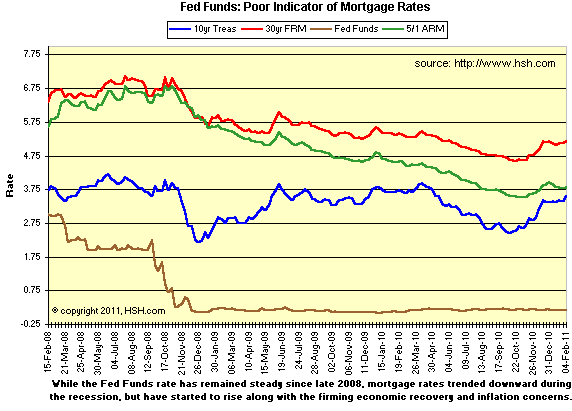
When it comes to determining where long-term mortgage rates are headed, forget the Fed Funds rate that we hear about when the media says "the Feds are cutting (or raising) rates". Conventional Mortgage rates move lock-step with the ten year Treasury bond rate. You can check the rate online using the ticker symbol "TNX". By the way, the ten-year rate is up 0.1870 to 3.83% today.

Follow this link to view a chart that shows the correlation between the two, and demonstrates how the Fed Fund rate doesn't affect mortgage rates. http://www.hsh.com/images/forgetfed.gif

But no one is saying that the Fed Fund rate doesn't matter. Short term borrowing and savings rates are strongly influenced by the Fed Fund rate.

Tuesday, June 16, 2009

Interest Rate Chonicles

Treasury yields fell slightly on Tuesday -- a welcome sign for mortgage loan officers who are trying to get their loans closed. Yields on long-term Treasuries had been climbing as demand for bonds weakens due to the surplus of government debt. Treasury yields are linked to mortgages and other consumer loans. Many are concerned that higher borrowing costs could slow a recovery in the housing market.

But (and it's a large but) Housing Starts were much higher than anticipated in May; increased confidence in the economy will encourage investors to take more risk and move out of safe but low-yield treasuries. And, according to an article in Bloomberg, "Russia, India, and China are buying each other's bonds to lessen dependence on the U.S. dollar". These are but two examples of forces that can contribute to the weakening demand for U.S. Treasuries, driving rates upward.
If the expected recovery stalls, rates may hold steady. But there are many indications that rates will continue to rise.

You will read this again and again on this blog. . . pay close attention to your ALM position and be PROACTIVE. Make any necessary adjustments to position your credit union for profitability in a changing rate environment - even if it hurts a little in the short-term.

Thursday, June 11, 2009

Interest Rate Chronicles

This is a direct quote from a Yahoo finance article:
"The government sold $19 billion in 10-year Treasury notes in a relatively weak auction. There were plenty of bidders, but the government had to lure them in with a higher yield than the market had anticipated. The yield on the benchmark 10-year Treasury note rose for the fourth time in five days, jumping to 3.95 percent from 3.86 percent late Tuesday."

The concern is that because the government must sell trillions in Treasuries in the coming months and years, the weak auction this early in the game could foretell that rates will rise faster than expected.

The moral of the story - sharpen your ALM pencil!

Wednesday, June 10, 2009

Interest Rate Chronicles

Russia has announced that they will be reducing the amount of U.S. Treasuries on their balance sheet. Whether this means they need the cash or they expect interest rates to rise is not relevant, the U.S. may find it a challenge to finance its unprecedented deficit spending going forward. Rates may have to rise to attract investors. (See June 9th blog "Mortgage Rates on the Rise).

Tuesday, June 9, 2009

Mortgage Rates are on the Rise

Advise your members who are "on the fence" regarding a mortgage refinance to consider moving now, before rate rise further. But consider selling them to Fannie or Freddie so you aren't "holding the bag" for a bunch of low-yielding assets a couple of years from now. However, if you are retiring soon, I wouldn't lose sleep over it because it becomes someone else's problem after you leave to travel around in your new Winnebago.

We have seen Mortgage rates rise in the last couple of weeks. Where will they go from here? Of course, no one has found a reliable way to determine which direction rates will move. However, it appears that investors are willing to take on more risk and move out of the safety of treasuries, lessening demand. While Mr. Geithner denies it, the Fed is monetizing debt by buying treasuries, and we are faced with unprecedented deficits. Inflation is a real threat. . . throw in a pinch of the possibility that foreign governments (read China) may shy away from buying U.S. debt and you have rates on their way up. We are discussing long-term rates here, but short-term rates are likely to follow. The Feds have recently said that they will do what is necessary (increase the target lending rate) to control inflation.

There are 10 year and 30 year Treasury auctions on June 10th and June 11th. Many consider these auctions to be an important bellwether. If demand is low, rates will increase in order to attract investors, and mortgage rates will follow.

Here's another way I know rates might be going up - our brokers are desperately trying to sell us mortgage-backed investments that they own. A restraining order may soon be necessary.

Tom Dluzen